

A permit gets pulled, a hood goes up, ductwork gets run, and everything looks finished, right up until the fire marshal walks through and finds the fire suppression system was never actually coordinated with the exhaust. That scenario plays out more often than most owners expect, and it usually traces back to the same root cause: the hood was installed by someone qualified to do mechanical work in general, but not qualified to do the specific work a Type I hood requires.
Type I hood systems sit at the intersection of fire code, mechanical code, and fire suppression, which is exactly why installation has to go to a licensed fabricator rather than a general HVAC company or a contractor treating it as one more item on a build-out punch list.
What Makes Type I Different From Standard Mechanical Work
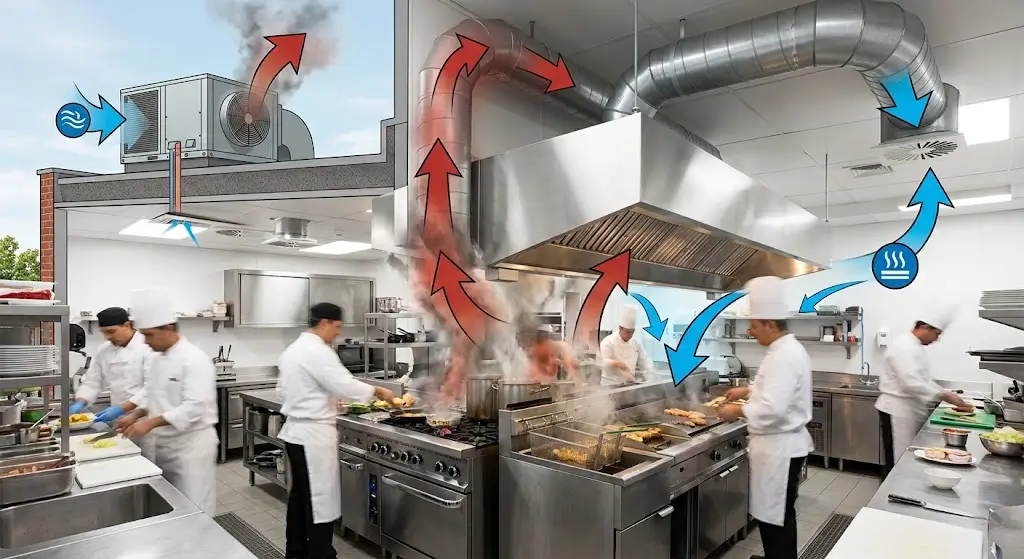
General HVAC work is built around comfort, moving conditioned air through a building efficiently. A Type I hood is built around something else entirely: capturing grease-laden vapor before it can accumulate, filtering it out of the airstream, moving it through fire-rated ductwork, and doing all of that in direct coordination with a fire suppression system designed to activate if a fire starts on the cook line.
That last piece is where general HVAC experience runs out. An HVAC technician can size ductwork for airflow all day long, but sizing and installing ductwork that also has to meet NFPA 96’s fire-rated construction and clearance requirements, while staying compatible with how the suppression system will respond during an activation, is a different skill set built around a different code.
The Licensing Question Isn’t Just a Formality
In states like Maryland, this isn’t only a matter of best practice, it’s a legal requirement. Maryland’s HVACR licensing statute specifically governs who can sell and install commercial hood systems, which means a general contractor or an HVAC company without that credential isn’t just under-qualified, they may not be legally permitted to do the work at all.
Even in states without an identical statute, the underlying logic holds. NFPA 96 and the International Mechanical Code set the bar for how these systems have to be built, and a licensed hood fabricator is the one whose core business is built around meeting that bar consistently, project after project.
Fabrication Knowledge Isn’t Optional Here
A Type I hood isn’t a product pulled off a shelf and bolted into place. It’s fabricated to fit the specific equipment underneath it, char broilers, fryers, griddles, whatever the menu requires, and sized to capture what that equipment actually produces. A fabricator who builds these systems regularly understands how equipment placement, ceiling height, and airflow all interact, because getting any one of those wrong undermines the hood’s ability to do its job.
A general contractor coordinating an entire build-out, plumbing, electrical, framing, finishes, and everything else, isn’t positioned to bring that same depth of expertise to one specific system, even if hood installation is technically within the scope of what they’ve agreed to manage. That’s not a knock on general contracting, it’s simply a different discipline than commercial kitchen exhaust fabrication.
What Goes Wrong When the Wrong Installer Takes the Job
The failure points tend to repeat themselves. Ductwork that doesn’t meet fire-rated clearance requirements. Fire suppression tie-ins that were never properly coordinated during installation. Grease filtration that wasn’t specified correctly for the equipment load. Any one of these can mean a failed inspection, and depending on the issue, correcting it after the fact can mean tearing out and reinstalling work that was already paid for once.
There’s also a liability dimension that doesn’t show up until something goes wrong operationally, a fire that doesn’t get contained the way the system was supposed to contain it, because the exhaust and suppression were never actually built to work together.
What Licensed Fabrication Actually Looks Like
A licensed hood fabricator approaches a Type I installation as one connected system, not a checklist of separate parts. That means the hood, ductwork, filtration, and fire suppression coordination are designed together from the start, based on the kitchen’s actual equipment, rather than assembled piece by piece from whoever happens to be on-site that week.
That’s the standard behind every Commercial Type I Hood Installation CRS Hoods completes, custom fabricated for the kitchen it serves, installed by people whose primary expertise is this specific category of work, not a side offering layered onto a broader construction scope.
Why This Distinction Holds Up Over Time
A hood system installed correctly the first time doesn’t just pass inspection, it keeps performing the way it’s supposed to for years of daily service. That reliability isn’t something a general contractor’s warranty can substitute for, because the issue isn’t workmanship in a general sense, it’s whether the person doing the work understood the specific fire and mechanical code requirements a Type I system has to meet.
Since 1980, CRS Hoods has installed more than 10,000 commercial kitchen exhaust systems across Pennsylvania, Delaware, and Maryland, with systems that consistently pass inspection on the first attempt. That consistency comes from treating every installation as fabrication work first, not general contracting with a hood attached.
Frequently Asked Questions
Can a general contractor legally install a Type I hood?
In states with specific HVACR licensing requirements, such as Maryland, a general contractor without that license may not be legally permitted to sell or install the system. Even where licensing law differs, a general contractor typically lacks the specialized fabrication background the work requires.
Why can’t a regular HVAC company handle Type I hood installation?
General HVAC work is built around comfort heating and cooling, not the fire-rated ductwork, grease filtration, and fire suppression coordination that define a Type I system, which is specialized fabrication work governed by NFPA 96.
What happens if a Type I hood is installed by an unqualified installer?
Common outcomes include failed inspections due to improper ductwork clearances or fire suppression coordination gaps, and in some cases, the kitchen fire risk the system was designed to reduce isn’t actually addressed correctly.
Does licensing affect more than just the initial installation?
Yes. A licensed fabricator is accountable to a state licensing board, which gives owners recourse that isn’t available with an unlicensed installer, and that accountability extends to how the system is designed, not just how it’s physically assembled.
What should an owner ask before hiring someone for Type I hood work?
Ask whether the company holds the required licensing in your state, whether hood fabrication is their core business or a side offering, and how the hood, ductwork, and fire suppression coordination are being designed together for your specific kitchen.