If you’re planning a commercial kitchen, the hood system is not optional equipment. It is required by code, tied directly to your menu, and one of the first things a health inspector and fire marshal will check before you open. Choosing the wrong type can mean redesign costs, permit delays, or a failed inspection right before opening day.
This is one of the most common questions restaurant owners ask before they’ve even finalized a kitchen layout, and it’s also one of the easiest to get wrong without the right guidance. Here is what you actually need to know before you order a hood system.
Type I vs. Type II Hoods
There are two main categories of commercial hoods, and the type you need depends entirely on what you are cooking.
Type I hoods are built for equipment that produces grease-laden vapor or smoke. This includes fryers, griddles, char-broilers, ranges, and ovens used for roasting or baking with grease-producing food. Type I hoods include built-in fire suppression systems, since grease buildup on ductwork and filters is one of the leading causes of commercial kitchen fires. If your menu involves frying, grilling, sauteing, or any high-heat cooking that releases grease into the air, you need a Type I hood. There is no way around this requirement, and no health department or fire marshal will approve a kitchen that skips it.
Type II hoods are designed for equipment that produces heat and steam but no grease or smoke. Dishwashers, steamers, and ovens used strictly for baking without grease output typically fall into this category. Type II hoods do not require fire suppression systems, since there’s no grease to ignite, but they still need to properly exhaust heat and humidity so the kitchen stays workable and code-compliant.
Some kitchens genuinely need both hood types, depending on the full equipment lineup across the line. A kitchen with a fryer station and a separate dish room, for example, may need a Type I hood over the cooking line and a Type II hood over the dish pit. This is exactly why hood planning should happen early, before your kitchen layout and equipment order are finalized, not after.
What Determines Which Hood You Need
Three factors drive this decision, and all three need to line up together:
- Your menu. Frying, grilling, and charbroiling always require Type I. A menu limited to baking, boiling, steaming, or reheating without grease-producing equipment may only need Type II.
- Your equipment list. The hood has to match the CFM, or airflow requirement, of every single piece of equipment sitting underneath it, not just the largest or most obvious one. Undersizing a hood for even one extra burner or fryer basket can mean the whole system fails to properly ventilate once the kitchen is running at full volume during a dinner rush.
- Local fire and building code. Requirements vary by jurisdiction. Some counties and municipalities enforce stricter clearance, makeup air, or fire suppression standards than the base code requires, and what passes in one town may need adjustment thirty minutes down the road.
Guessing at this stage is where most delays happen. A hood sized wrong for your equipment either fails inspection outright or technically passes but never properly ventilates the kitchen once you’re cooking at capacity, which creates smoke buildup, heat problems, and staff discomfort that shows up months after opening.
Do I Need Makeup Air (MUA)?
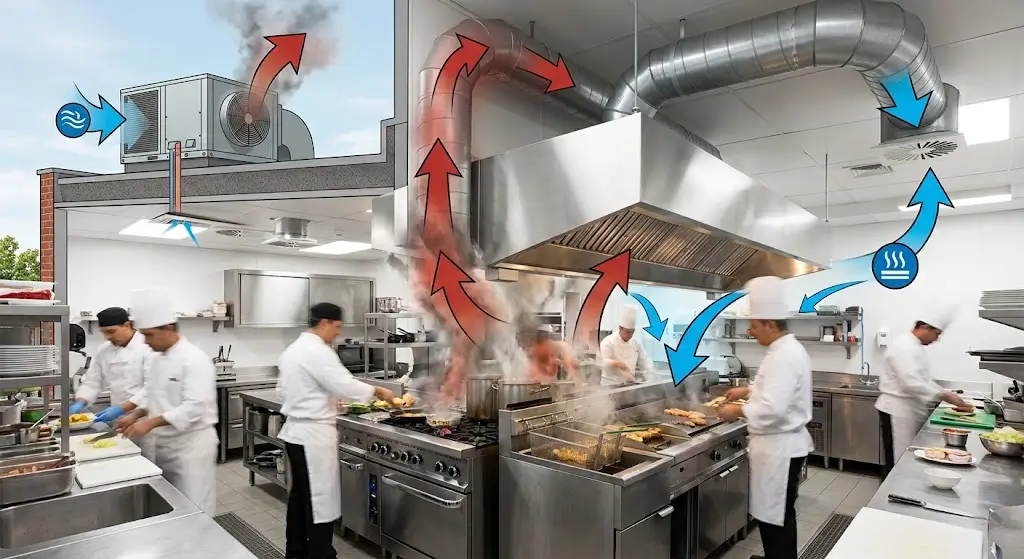
In most cases, yes. When a hood exhausts air out of the building, that air has to be replaced from somewhere, or the kitchen creates negative pressure. Negative pressure makes exterior doors difficult to open, pulls conditioned air out of the building faster than your HVAC system can keep up, and in worse cases can pull combustion gases back into the kitchen from water heaters, furnaces, or other gas-fired equipment nearby.
Makeup Air Units, commonly called MUA, bring in replacement air to balance what the hood exhausts, often tempering that air so the kitchen isn’t blasted with unconditioned outside air in the middle of summer or winter. Most code jurisdictions require MUA once your exhaust hits a certain CFM threshold, and nearly every commercial kitchen running a Type I hood crosses that threshold. Skipping MUA, or installing an undersized unit, is one of the more common reasons a system passes a paper inspection but performs poorly in daily use.
Balancing exhaust and makeup air correctly takes actual calculation, not a rule of thumb. This is one of the areas CRS Hoods focuses on directly with every installation, since a hood and its makeup air have to function as a single coordinated system rather than two separate pieces of equipment bolted together.
Who Builds the Ductwork?
Exhaust ductwork and MUA ductwork are specialized work, not general HVAC. Grease duct has specific clearance, slope, and fire-rating requirements under mechanical code, and it typically needs to be:
- Installed by a licensed mechanical or ventilation contractor experienced specifically in commercial kitchen exhaust systems
- Inspected before it’s enclosed inside walls or ceilings, since problems found after enclosure mean tearing work back open
- Sloped correctly back to a grease collection point so grease doesn’t pool inside the ductwork itself
- Fabricated and welded with continuous, liquid-tight seams, since grease leaks at duct joints are one of the leading causes of kitchen fires and failed inspections
Makeup air ductwork has its own requirements around balancing airflow with the exhaust hood so the two systems work together rather than fighting each other. This is detailed, code-heavy work, and it’s a large part of why CRS Hoods’ commercial hood installation services exist as a dedicated specialty rather than a side offering from a general contractor.
What Code Applies?
Hood installation typically falls under a combination of:
- The International Mechanical Code (IMC), which most states adopt in some form as their baseline mechanical code
- NFPA 96, the national standard covering ventilation control and fire protection for commercial cooking operations
- Local fire marshal requirements, which can add restrictions on top of the base code, particularly around clearance to combustibles and fire suppression integration
Because code adoption varies by state, and sometimes even by county within the same state, the same hood setup that passes inspection in one location may need adjustments in another. Contractors licensed and actively working across multiple states tend to catch these differences before they become a problem at final inspection, rather than after. It’s worth confirming code specifics with your local building department before finalizing equipment orders, not after ductwork is already installed.
Getting It Right the First Time
Hood systems are one of the few pieces of restaurant build-out where the equipment, the ductwork, the makeup air, the fire suppression, and the code compliance all have to work together as a single system rather than as separate purchases. Ordering the wrong hood type, skipping or undersizing makeup air, or hiring an installer unfamiliar with commercial kitchen exhaust are the most common reasons projects stall at inspection, sometimes just days before an opening date.
If you’re planning a new restaurant or upgrading an existing kitchen, get your hood sized and specified before you finalize your equipment layout. It’s far easier and cheaper to correct on paper than after installation. Since 1980, CRS Hoods has installed more than 10,000 commercial kitchen exhaust systems across Pennsylvania, New Jersey, Delaware, and Maryland, engineered specifically to pass inspection the first time. If you’d like a hood system properly sized and specified for your kitchen before you order equipment, request a free consultation to get started.
FAQs
Do I need a Type I or Type II hood for my restaurant?
It depends on your cooking equipment. Any frying, grilling, or high-heat cooking that produces grease-laden vapor requires a Type I hood with fire suppression. Equipment that only produces heat or steam, like dishwashers or steamers, only needs a Type II hood.
Is makeup air (MUA) always required?
Not always, but most commercial kitchens with a Type I hood exceed the CFM threshold that triggers the MUA requirement in most jurisdictions. Confirm the exact threshold with your local code official or an experienced installer.
Who is qualified to install hood ductwork?
A licensed mechanical or ventilation contractor with experience in commercial kitchen exhaust systems, since grease duct has specific slope, clearance, and fire-rating requirements that general contractors may not be familiar with.
What happens if I install the wrong hood system?
You risk failing your health and fire inspections, needing to redo ductwork or equipment layout, and delaying your opening date. It can also mean added cost if walls or ceilings already enclose the incorrect ductwork.
Does hood code differ by county or state?
Yes. Most areas adopt the International Mechanical Code and NFPA 96 as a baseline, but local fire marshals can add stricter requirements. Always check with your local building department, or a contractor licensed in your state, before finalizing your hood order.