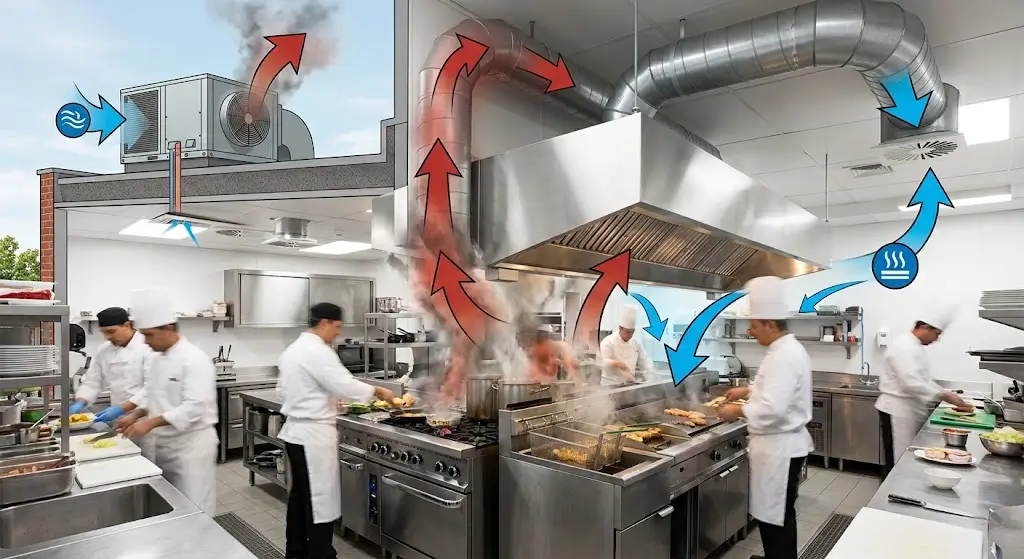


The most common commercial exhaust fan installation mistakes almost always trace back to the same root cause: a system installed without accounting for the specific kitchen, equipment, and code requirements behind it. Wrong fan sizing, poor roof mounting, unbalanced makeup air, and skipped code steps are the mistakes that show up again and again, and every one of them is preventable with the right fabricator handling the job from the start. For restaurant owners searching for reliable commercial exhaust fan installation & repair in Delaware, knowing what typically goes wrong is the fastest way to avoid it happening on your own project.
An exhaust fan is not a standalone piece of equipment. It works as part of a larger system alongside the hood, ductwork, and makeup air setup, and a mistake in any one part of that system tends to create problems in the others. Understanding where installations commonly go wrong helps explain why this work belongs with a licensed, experienced fabricator rather than a general HVAC company or contractor.
Mistake One: Sizing the Fan Without Assessing the Full System
One of the most frequent mistakes is selecting an exhaust fan based on general assumptions rather than the actual kitchen it will serve. Fan capacity needs to match the hood it is paired with, the equipment underneath that hood, and the ductwork configuration connecting them. A fan that is undersized will struggle to exhaust properly, while an oversized fan can create excess noise, energy waste, and airflow imbalance elsewhere in the kitchen.
There is no universal fan size that works across every commercial kitchen. The right specification depends on the heat output of the equipment, the hood’s design, and the length and configuration of the ductwork run. This is precisely why fan selection should come out of a real site assessment, not a generic sizing chart.
Mistake Two: Poor Roof Curb and Mounting Work
Exhaust fans are typically mounted on the roof, and the curb they sit on plays a bigger role than most owners realize. A poorly sealed or improperly flashed curb is one of the most common sources of roof leaks tied back to exhaust fan installation. Beyond water intrusion, an unstable or incorrectly sized curb can also lead to vibration issues, premature wear on the fan motor, and problems that are far more expensive to correct once the roofing membrane has already been compromised.
Getting curb and mounting work right requires understanding both the fan’s specifications and the roofing system it interacts with, which is another reason this work should be handled by fabricators experienced in commercial kitchen exhaust systems specifically, not a general contractor unfamiliar with how these systems perform under continuous use.
Mistake Three: Ignoring Makeup Air Balance
An exhaust fan does not operate in isolation. For every cubic foot of air it removes from the kitchen, that air needs to be replaced, or the space develops negative pressure that can pull conditioned air from the rest of the building, make doors difficult to open, or cause the exhaust system to underperform even when the fan itself is functioning correctly.
Makeup air balance is one of the most overlooked factors in exhaust fan installation because the problem is not always obvious right away. A kitchen can pass initial startup and still struggle with airflow issues that surface weeks or months later, once the imbalance compounds. Getting this right requires evaluating the exhaust fan and makeup air system together, not treating them as two separate installations.
Mistake Four: Skipping or Rushing Code Requirements
NFPA 96 and the International Mechanical Code govern how commercial kitchen exhaust systems, including exhaust fans, need to be installed. These are not background guidelines. A restaurant cannot legally open or continue operating if its exhaust system does not meet code, in the same way a new driver cannot legally get behind the wheel without following basic traffic laws.
Common code-related mistakes include improper clearances around the fan, inadequate access for maintenance and cleaning, and ductwork terminations that do not meet fire and safety separation requirements. These issues often go unnoticed until an inspection catches them, at which point the fix usually costs more time and money than doing it correctly the first time would have.
Mistake Five: Hiring an Unlicensed or Unqualified Installer
Commercial exhaust fan work is specialized fabrication and installation work, not a task that fits neatly into a general HVAC or general contracting scope. In several states, purchasing a commercial hood and exhaust system legally requires working with a company holding proper HVACR licensing. That requirement exists for a reason: exhaust fan systems interact with fire safety, air quality, and structural considerations that a general contractor is not necessarily trained to evaluate.
Hiring an unlicensed or unqualified installer is where many of the mistakes above actually originate. Incorrect sizing, poor mounting, ignored makeup air balance, and skipped code steps are far more likely when the installer lacks specific experience with commercial kitchen exhaust systems.
Mistake Six: Treating the Fan as a Standalone Purchase
Some installations go wrong simply because the exhaust fan was treated as an isolated equipment purchase rather than part of a custom-fabricated system built around the specific kitchen. A fan that was not selected and fitted to match the hood, ductwork, and makeup air setup it works alongside is far more likely to underperform, even if the fan itself is a quality unit.
Custom fabrication addresses this by designing the fan into the broader exhaust system from the start, rather than retrofitting a generic product into a space it was never built for. This is also where experience specific to commercial kitchen exhaust work matters more than general familiarity with HVAC equipment.
Why These Mistakes Are Preventable
Every mistake covered here shares the same root cause: a decision made without a full site assessment of the kitchen, equipment, ductwork, and code requirements involved. None of them are the result of bad luck. They happen when exhaust fan installation is treated as a quick equipment swap rather than the specialized, code-governed work it actually is.
Coordinating With Other Systems and Trades
Exhaust fan installation often overlaps with roofing work, electrical connections, and broader kitchen build-out timelines. It is worth being clear that coordinating those other trades and vendors across a project ultimately falls to the owner or the general contractor managing the build. A licensed fabricator’s role is to design, fabricate, and install a code compliant exhaust fan system for the specific kitchen involved, not to manage the surrounding construction schedule.
Getting It Right From the Start
Avoiding these common mistakes comes down to one thing: working with a fabricator who evaluates your actual kitchen instead of applying a generic solution. Fan sizing, roof mounting, makeup air balance, and code compliance all depend on the specific conditions of your space, and a proper site assessment is the only way to get each of those factors right the first time.
If you are planning an exhaust fan installation or repair and want it built around your kitchen’s real conditions, a professional site assessment is the place to start.
Frequently Asked Questions
What is the most common mistake in commercial exhaust fan installation?
Selecting a fan based on general assumptions rather than the actual kitchen it serves is one of the most frequent mistakes. Fan capacity needs to match the hood, equipment, and ductwork configuration, which is why sizing should come from a real site assessment, not a generic chart.
Can a poorly installed roof curb cause problems beyond leaks?
Yes. Beyond water intrusion, an unstable or incorrectly sized curb can cause vibration issues and premature wear on the fan motor. These problems often become far more expensive to fix once the surrounding roofing membrane has already been compromised.
Why does makeup air balance matter for exhaust fan performance?
Every cubic foot of air an exhaust fan removes needs to be replaced, or the kitchen develops negative pressure that can pull conditioned air from the building and reduce exhaust performance. This imbalance is often overlooked because problems can surface weeks after installation.
Does a general contractor have the qualifications to install a commercial exhaust fan?
Exhaust fan work is specialized fabrication and installation work governed by NFPA 96 and the IMC. In several states, purchasing a commercial hood and exhaust system legally requires a company holding proper HVACR licensing, which general contractors typically do not carry.
Can an exhaust fan installation fail inspection even if the fan works?
Yes. A functioning fan does not guarantee code compliance. Issues like inadequate clearances, improper ductwork termination, or missed access requirements for maintenance can all lead to a failed inspection even when the fan itself operates correctly.
Is repairing an existing exhaust fan different from a new installation?
Repair work still needs to account for the system it is part of, including hood compatibility, ductwork condition, and makeup air balance. Treating a repair as an isolated fix, without evaluating the surrounding system, can leave the same underlying issues unresolved.