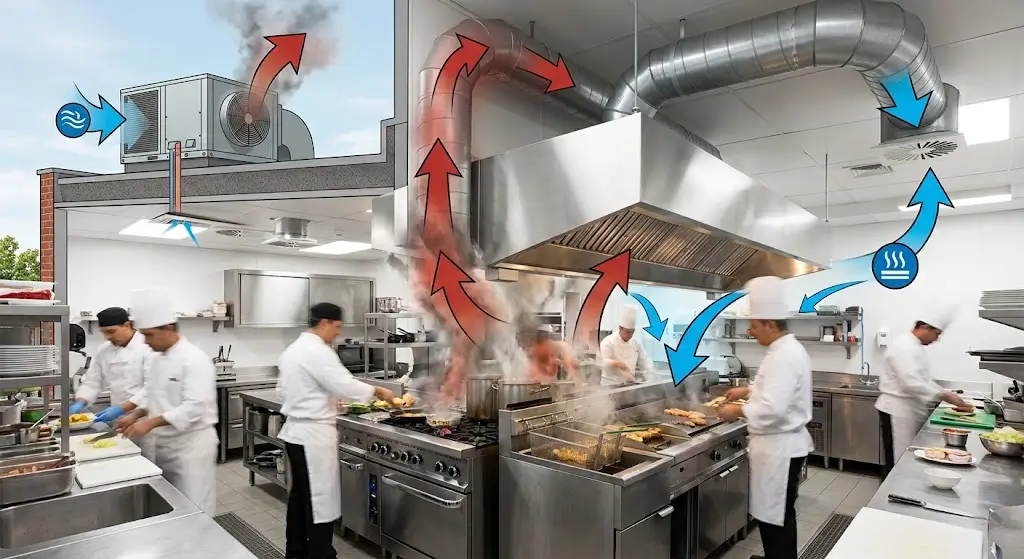


A commercial kitchen ventilation system prevents fires by capturing and removing grease-laden vapor before it can accumulate, filtering grease out of the airstream, and integrating directly with fire suppression equipment so a fire is contained rather than fed by the exhaust system itself. Fire prevention isn’t a side benefit of ventilation, it’s one of the core reasons the system exists, and it’s why commercial kitchen exhaust is governed by fire code rather than treated as a general air-quality feature.
Understanding how each part of the system contributes to fire prevention makes it clear why proper design, installation, and maintenance matter well beyond passing an inspection.
Grease Is the Root of the Risk
Most commercial kitchen fires that start in the ventilation system trace back to grease. Cooking produces grease-laden vapor that rises off the equipment, and if that vapor isn’t captured effectively, it settles inside the hood, the ductwork, and the exhaust fan. Over time, that buildup becomes fuel sitting directly inside a system that also carries heat.
This is why the capture stage at the hood matters so much. A hood that’s properly sized and positioned for the equipment underneath it captures grease-laden vapor before it can escape into the surrounding air or settle where it’s hard to clean. A hood that doesn’t fully capture that vapor allows grease to spread beyond the system entirely, onto ceiling tiles, walls, and other surfaces where it becomes even harder to manage.
Filtration Removes Grease Before It Travels Further
Once vapor is captured, it passes through grease filters before entering the ductwork. These filters are designed to trap grease particles so they don’t travel deeper into the exhaust system, where buildup is much harder to detect and clean.
Filters have to be maintained for this function to keep working. A clogged or poorly maintained filter doesn’t just reduce airflow, it allows more grease to pass through into the ductwork, increasing the fuel load sitting inside a system that’s also handling heat from daily cooking operations.
Ductwork Design Limits Where Grease Can Collect
Ductwork isn’t just a path for air, it’s engineered under NFPA 96 with specific requirements around material, clearances, and construction that limit where grease can accumulate and make the system easier to inspect and clean. Ducts built and installed to code specifications reduce the number of places grease can collect undetected, which directly reduces fire risk over the life of the system.
This is one of the reasons ductwork construction and installation shouldn’t be treated as a generic sheet metal task. It’s a component of a fire protection system, and it’s engineered and installed with that function in mind.
Integration With Fire Suppression
A kitchen ventilation system doesn’t operate independently of the fire suppression system, the two are designed to work together. In the event of a fire, the suppression system needs to activate correctly, and the ventilation system needs to respond in a way that helps contain the fire rather than feeding it more air or spreading it further through the ductwork.
This integration is a major reason kitchen ventilation is addressed so specifically under NFPA 96, rather than left to general HVAC or mechanical code. The system has to be designed with fire behavior in mind from the start, not treated as a mechanical system that happens to share space with fire suppression equipment.
Why Cleaning and Maintenance Are Fire Prevention, Not Housekeeping
Regular cleaning of the hood, filters, and ductwork is often thought of as routine maintenance, but its real function is fire prevention. Grease that accumulates over time inside a system that isn’t cleaned on schedule becomes exactly the fuel source that turns a small kitchen fire into one that spreads through the exhaust system.
This is why cleaning frequency and inspection requirements aren’t arbitrary. They’re tied directly to how much a kitchen cooks, what type of equipment it uses, and how quickly grease can build up in that specific system, which is another example of why generic advice doesn’t apply evenly across different kitchens.
Why This Depends on Proper Design From the Start
Fire prevention through ventilation only works if the system was designed and installed correctly in the first place. A hood that’s undersized for the equipment underneath it, ductwork that doesn’t meet clearance requirements, or a system that isn’t properly coordinated with fire suppression can undermine fire prevention regardless of how well it’s maintained afterward.
This is why commercial kitchen ventilation is best handled by a licensed hood fabricator who understands how these components work together, rather than a general HVAC company or general contractor treating it as a standard mechanical install.
Since 1980
Since 1980, CRS Hoods has installed more than 10,000 commercial kitchen exhaust systems across Pennsylvania, New Jersey, Delaware, and Maryland, with systems that consistently pass inspection on the first attempt. That consistency reflects designing every system with fire prevention built in from the start, not added on afterward.
Every kitchen’s fire risk comes down to its specific equipment, grease load, and layout, which is why CRS Hoods designs every ventilation system with fire prevention built in from the first site assessment, not treated as an afterthought.
Frequently Asked Questions
How does a kitchen hood help prevent fires?
A properly sized and positioned hood captures grease-laden vapor before it can escape into the kitchen or settle inside the exhaust system, reducing the amount of grease available to fuel a fire.
Why is ductwork construction important for fire safety?
Ductwork built to NFPA 96 requirements limits where grease can accumulate and makes the system easier to inspect and clean, which reduces the risk of undetected grease buildup becoming a fire hazard.
Does cleaning a ventilation system actually prevent fires?
Yes. Grease accumulation inside a hood, filters, or ductwork is one of the leading causes of commercial kitchen fires. Regular cleaning removes that fuel source before it can build up to a dangerous level.
How does ventilation work with fire suppression?
The exhaust system is designed to respond appropriately when the fire suppression system activates, so airflow doesn’t spread a fire further through the ductwork. The two systems are engineered to work together, not independently.
Why can’t any HVAC company handle this kind of installation?
Because fire prevention depends on how the hood, ductwork, and fire suppression coordination are designed together, this work requires the specific expertise of a licensed hood fabricator, not general HVAC or mechanical installation experience.