


KITCHEN VENTILATION SYSTEM
Extractor Fans That Keep the Air Moving — and the Inspector Happy
Every commercial kitchen needs somewhere for heat, smoke, and grease vapor to go. That’s what a kitchen ventilation system is for: a coordinated setup of hoods, ductwork, exhaust fans, and make-up air that pulls contaminated air out and brings clean air back in, all while satisfying the fire codes standing between your kitchen and its opening day.
CRS Hoods designs, fabricates, and installs complete kitchen ventilation systems for restaurants, institutional kitchens, food trucks, and commercial food service operations across Delaware, Pennsylvania, New Jersey, and Maryland. Request a quote below, or keep reading to see exactly what goes into a system that’s sized right and built to last.
WHAT IS A KITCHEN VENTILATION SYSTEM, EXACTLY?
A kitchen ventilation system is not a single appliance. It is a set of components engineered to work together:
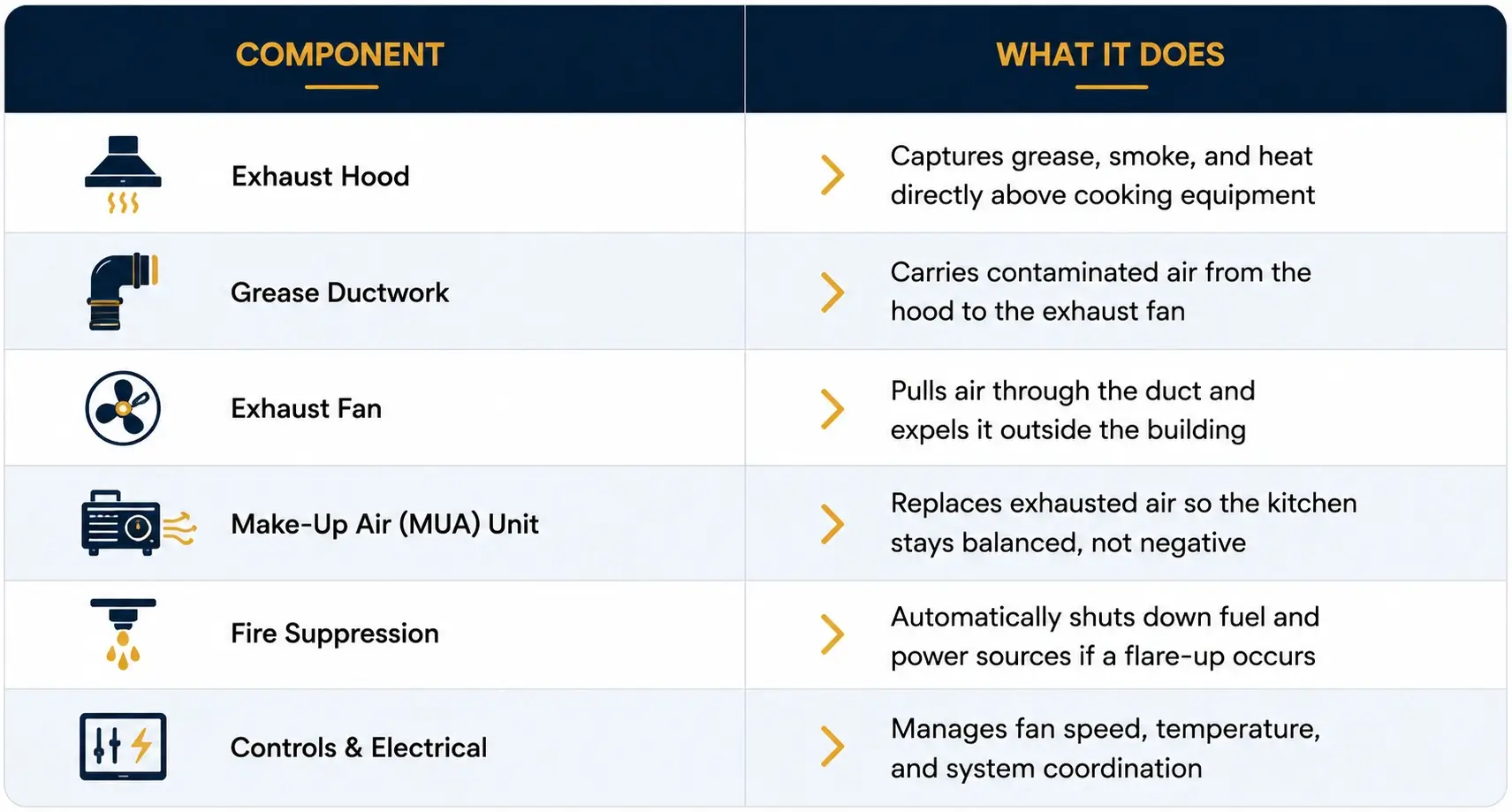
Each piece has to be sized against the others. A hood without a correctly matched fan will underperform no matter how well it’s built. That’s the difference between buying parts and having a system designed.
SIGNS YOUR CURRENT SYSTEM ISN'T DOING ITS JOB
You probably don’t need a manual to tell you something’s off. These are the most common complaints we hear before a kitchen calls us:
- Smoke or haze lingers over the line instead of clearing quickly.
- The front door feels heavy, or it whistles when someone opens it.
- Staff complain about heat, especially by the second half of a shift.
- Grease residue shows up on surfaces near the hood or duct access panels.
- The air conditioning seems to be working overtime without much payoff.
- An inspector has flagged something, or a health or fire inspection is coming up.
Any one of these points to a system that isn’t sized, balanced, or maintained the way it should be. Left alone, they tend to get worse, not better.
OUR KITCHEN VENTILATION SYSTEM SERVICES
Design & Engineering
We calculate your CFM requirements based on hood length, cooking equipment, and duct routing, then build a system design around the numbers, not an assumption.
New System Installation
Ground-up ventilation installs for new restaurants, kitchen conversions, food trucks, and commissary builds.
System Replacement & Upgrades
Swap out an aging or undersized system for one that matches your current cooking volume and equipment lineup.
Exhaust Hood Fabrication (Type I & Type II)
Custom-fabricated hoods built for grease-producing equipment or general heat and steam removal, whichever your kitchen requires.
Exhaust Fan & Make-Up Air Installation
Upblast, centrifugal, and inline fan options, balanced against a properly sized MUA unit so your kitchen doesn’t run negative.
Grease Duct Fabrication
Continuous, liquid-tight welded ductwork, built to the clearance and construction standards your inspector will be checking for.
Fire Suppression Coordination
We install the hood and ductwork, and coordinate directly with licensed suppression contractors so everything connects and passes inspection together.
Inspection, Repair & Maintenance
Ongoing service to keep an existing system compliant, efficient, and ready for its next inspection.
HOW WE APPROACH EVERY VENTILATION PROJECT
On-Site Assessment
We walk your kitchen, review your equipment lineup, and take real measurements. Nothing gets quoted off a floor plan alone.
CAD-Backed System Design
Your hood, duct, fan, and MUA get engineered together as one system, sized to your specific CFM requirements.
Fabrication
Hoods and ductwork are fabricated to spec, using continuous, liquid-tight welds and code-compliant materials throughout.
Installation
Our licensed team installs the complete system, coordinating with fire suppression and electrical as needed.
Inspection Walkthrough
We verify the finished system meets NFPA 96 and International Mechanical Code requirements before your official inspection date.
INDUSTRIES AND FACILITIES WE SERVE
Full-Service Restaurants
High-heat cooking lines with fryers, charbroilers, and multiple hood zones running for extended service hours. These kitchens usually need the highest CFM capacity and the tightest airflow balance, since a packed dinner rush leaves zero room for smoke or heat buildup.
Quick-Service and Fast Casual
Compact kitchens running high-volume frying and grilling in a smaller footprint. Ventilation here has to work hard in tight spaces, often with less room for oversized equipment, so accurate sizing matters even more than in a full-service kitchen.
Cafes and Bakeries
Lower grease load, but ovens and steam-producing equipment still generate real heat and moisture. These spaces often qualify for Type II ventilation rather than full grease-rated systems, which changes both the equipment and the cost.
Bars and Pubs
Limited-menu kitchens (think fryers and flat-tops) paired with front-of-house spaces where smoke drift or negative pressure is especially noticeable to guests. Air balance matters as much here as raw exhaust power.
Hotels and Resorts
Multiple kitchens under one roof, room service, banquet halls, restaurants, sometimes a bar, each running on its own schedule. Systems need to scale across several ventilation zones without one kitchen’s exhaust throwing off another’s.
Schools and Universities
High-volume, batch-style cooking on a tight daily schedule, often in older buildings with retrofit constraints. Code compliance and budget efficiency tend to matter just as much as raw performance.
Hospitals and Healthcare Facilities
Continuous kitchen operation feeding patients and staff around the clock, with strict air quality and cross-contamination standards layered on top of standard fire code. Little to no tolerance for downtime.
Food Trucks and Mobile Kitchens
Full cooking equipment crammed into a tiny footprint, with ventilation systems that have to meet the same fire code standards as a full kitchen while fitting a fraction of the space.
Institutional and Government Cafeterias
Large-scale, high-volume cooking on a consistent daily routine, usually with strict procurement and compliance documentation requirements on top of the standard code checks.
Frequently Asked Questions
How much does a commercial kitchen ventilation system cost?
Cost depends on hood size, duct length, fan type, and whether make-up air and fire suppression need to be added or upgraded. A small single-hood setup costs far less than a full-line installation with multiple pieces of grease-producing equipment. The only way to get an accurate number is a site assessment, which is why we start every project there instead of quoting blind.
How long does installation take?
A straightforward replacement on existing infrastructure can often be completed in a matter of days. A full new-build system, especially one requiring new ductwork, electrical work, and fire suppression coordination, typically takes longer and depends on permitting timelines in your specific jurisdiction.
Do I need a new system, or can my existing one be upgraded?
In many cases, upgrading is possible. If your hood and ductwork are still structurally sound and code-compliant, we can often replace or upgrade just the fan, make-up air unit, or specific components rather than starting from scratch. We’ll tell you honestly which route makes more sense during the on-site assessment.
What size exhaust hood and fan do I need?
This comes down to your hood’s CFM rating, which is calculated from hood length, the type of cooking equipment underneath it, and your duct run. Fryers and charbroilers require significantly more airflow than a convection oven, for example. We calculate this on-site for your actual equipment lineup rather than estimating from a generic chart.
Will a new ventilation system pass inspection the first time?
That’s the standard we build to. Every installation is designed around NFPA 96 and International Mechanical Code requirements, with attention to the specific details inspectors check most closely: CFM match, duct clearance, weld integrity, and air balance.
GET YOUR KITCHEN VENTILATION SYSTEM QUOTE
Tell us about your kitchen, your equipment, and your timeline. We’ll schedule a site visit, calculate exactly what your space needs, and give you a straightforward quote before we ever touch a tool.
Call 302-653-4111 or fill out the form below.