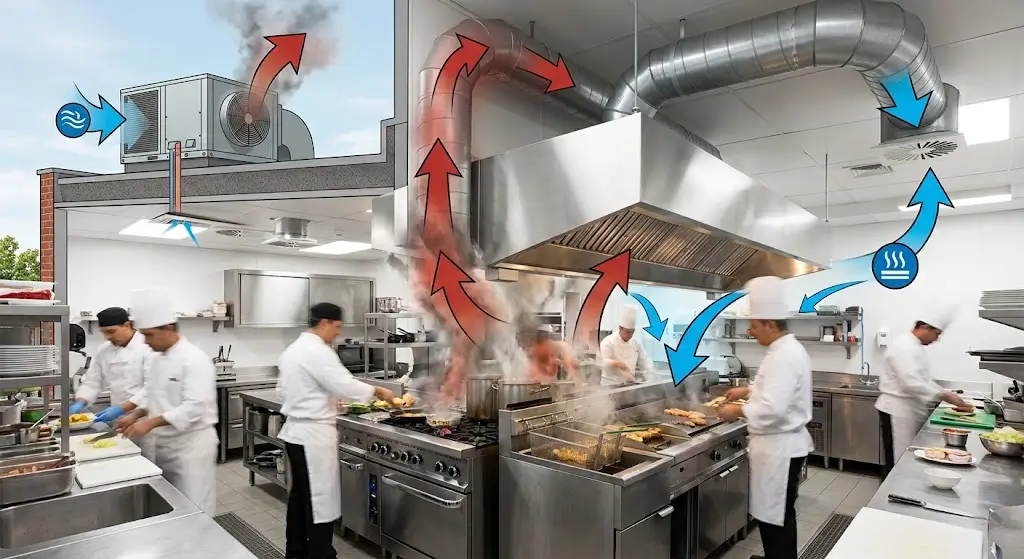


Yes, and this is where a lot of restaurant owners get overwhelmed. It’s not just a choice between Type I and Type II. Once you know which type your menu requires, there’s a second layer of decisions around canopy style, exhaust configuration, and fan setup that determines whether the hood actually fits your kitchen and performs the way it should.
Ordering a hood isn’t picking a size off a shelf. It’s matching a specific configuration to your equipment layout, your building’s structure, and how your kitchen is used day to day. Here’s what actually varies.
Canopy Style: Wall-Mounted vs. Island vs. Backshelf
The canopy is the visible part of the hood sitting above your cooking equipment, and its shape depends entirely on where that equipment sits in the kitchen.
Wall-mounted canopy hoods sit against a wall, with cooking equipment lined up underneath along that wall. This is the most common setup in smaller kitchens where equipment runs along one side of the room.
Island canopy hoods are used when cooking equipment sits in the middle of the kitchen, away from any wall, often on a cook line visible to customers or positioned for staff to work around from all sides. These hoods have to capture exhaust from a wider area since there’s no wall to help contain airflow, which usually means a larger canopy and higher CFM requirement than a wall-mounted equivalent covering the same equipment.
Backshelf hoods are compact units designed to sit directly behind counter equipment, common in smaller footprint kitchens like food trucks, concession stands, or tight commercial spaces where a full canopy isn’t practical.
Choosing the wrong canopy style for your floor plan is one of the most common reasons a hood ends up undersized for the space, even when the CFM math technically checks out on paper.
Exhaust-Only vs. Compensating Hoods
Some hoods only exhaust air out of the building, relying entirely on a separate makeup air unit to replace it. Others, called compensating hoods, have makeup air built directly into the hood itself, delivering replacement air right at the hood face instead of through separate ductwork elsewhere in the kitchen.
Compensating hoods can simplify installation in kitchens where running separate makeup air ductwork isn’t practical, but they come with their own balancing requirements to make sure the air delivered at the hood doesn’t disrupt the capture of grease-laden vapor. Getting this balance wrong can actually push smoke and grease out into the kitchen instead of up into the hood.
Single-Fan vs. Multi-Fan Systems
Larger kitchens with long cook lines or multiple hood sections sometimes need more than one exhaust fan working together rather than a single oversized fan trying to pull air across the entire line. Multi-fan systems can also add redundancy, since a single fan failure doesn’t shut down ventilation across the whole kitchen if a second fan can carry partial airflow until repairs happen.
Smaller kitchens with one hood section over a shorter equipment run typically only need a single, correctly sized fan.
UL 300 Fire Suppression Compatibility
Any Type I hood needs a fire suppression system rated to UL 300 standards, but not every suppression system is compatible with every hood configuration out of the box. Nozzle placement, the number of nozzles required, and how the suppression system integrates with the hood’s exhaust plenum all depend on the specific hood design and the equipment sitting beneath it. This is typically engineered alongside the hood itself rather than added on afterward, since retrofitting suppression onto a hood that wasn’t designed for it usually means added fabrication work.
Filter Type
Grease filters mounted inside the hood also vary. Baffle filters are standard in most Type I applications and are effective at trapping grease while allowing decent airflow. Some specialty applications use extractor-style or cartridge filters designed for higher grease loads, common in high-volume frying or wok stations where standard baffle filters would need constant cleaning to stay effective.
Why This Matters Before You Order
Two restaurants can both need a “Type I hood” and still end up with completely different equipment once canopy style, exhaust configuration, fan count, and filter type are factored in. Ordering based on type alone, without accounting for kitchen layout and equipment specifics, is a common reason hoods arrive that don’t fit the space or don’t perform once installed.
This is why hood specification should happen alongside kitchen layout planning, not after equipment has already been ordered or a floor plan finalized. A licensed hood installer can walk the specific configuration through with you, including canopy type, fan setup, and suppression compatibility, before anything is fabricated.
FAQs
What’s the difference between a wall-mounted and island hood?
A wall-mounted hood sits against a wall with equipment lined up beneath it, while an island hood sits over equipment positioned away from any wall and typically needs a larger canopy and higher airflow to properly capture exhaust from all sides.
What is a compensating hood?
A compensating hood has makeup air built into the hood itself, delivering replacement air at the hood face instead of through separate ductwork. It can simplify installation but requires careful balancing to avoid disrupting grease capture.
Do all Type I hoods need the same fire suppression system?
No. Fire suppression has to be engineered to match the specific hood design, including nozzle count and placement, so it’s typically planned alongside the hood rather than retrofitted afterward.
Why would a kitchen need multiple exhaust fans instead of one?
Larger kitchens with long cook lines sometimes need multiple fans working together for even airflow across the whole line, and multi-fan setups can add redundancy if one fan needs repair.
Does filter type matter for hood performance?
Yes. Standard baffle filters work well for most Type I setups, but high-volume frying or wok stations may need extractor or cartridge filters designed to handle heavier grease loads without constant cleaning.