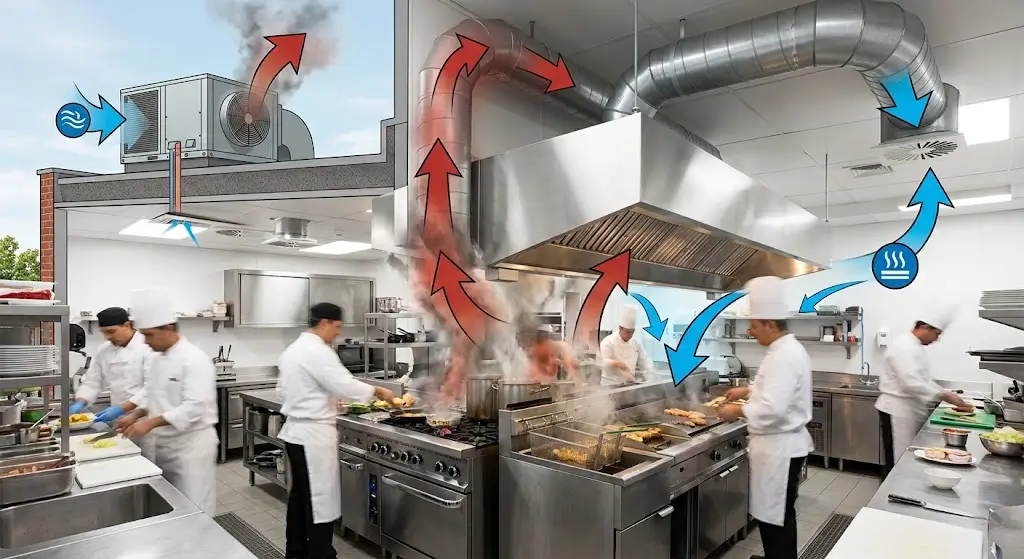


Commercial kitchens typically rely on one of three general categories of exhaust fans: upblast, downblast (also called utility set), and inline. Each category moves air differently, mounts differently, and suits different kitchen layouts and equipment lineups. Knowing the difference matters, but knowing which one actually belongs on your kitchen is a separate question, one that depends on your specific hood system, ductwork configuration, and code requirements rather than a generic preference for one type over another.
This is worth understanding before a project starts, because the wrong fan category for a given kitchen setup can lead to airflow problems, code issues, or a system that underperforms even when every individual component is technically functional. If you are weighing your options for Commercial exhaust fan installation & repair in Delaware, understanding these categories upfront makes that conversation far more productive.
Upblast Exhaust Fans
Upblast fans are among the most common choice for commercial kitchen exhaust systems, particularly where grease-laden vapors are involved. They are designed to discharge exhaust air straight upward, away from the roof surface, which helps keep grease and airborne particulate from settling directly onto the roofing membrane below the fan.
This upward discharge pattern is one of the reasons upblast fans are frequently specified for Type I hood systems, where grease exhaust is a primary concern. Because the airflow moves vertically and away from the roof, upblast fans also tend to reduce the risk of grease buildup pooling near the fan base, which is a maintenance and fire safety consideration under NFPA 96.
Whether an upblast fan is the right fit for a specific kitchen still depends on factors like ductwork length, roof structure, and the heat and volume of exhaust the hood system needs to handle.
Downblast and Utility Set Exhaust Fans
Downblast fans, sometimes referred to as utility set fans, discharge air downward or horizontally rather than straight up. They are more commonly associated with general ventilation and Type II applications, where the exhaust stream is primarily heat and steam rather than grease-laden vapor.
Because grease is not the central concern with most Type II applications, the downward or horizontal discharge pattern is less of a fire and maintenance issue than it would be on a grease-heavy Type I system. Utility set fans are also sometimes selected for their lower roofline profile, which can matter depending on building aesthetics or roof access requirements.
As with upblast fans, whether a downblast or utility set fan is appropriate depends on the equipment it is paired with and the type of exhaust the hood system is actually managing, not a blanket rule that applies to every non-grease application.
Inline Exhaust Fans
Inline fans are mounted within the ductwork run itself rather than directly on the roof above the hood. This placement can be useful in kitchens where roof access is limited, where the hood needs to be positioned away from the fan for layout reasons, or where noise from the fan needs to be located farther from the cooking area.
Inline fans require careful attention to ductwork design, since their performance depends heavily on how the duct run is configured leading up to and away from the fan itself. A duct system that was not designed with an inline fan’s specific airflow characteristics in mind can lead to reduced performance, which is one of the reasons this fan type benefits from being planned as part of the overall system design rather than added on after the fact.
Why the Right Type Depends on the System, Not a General Rule
None of these categories is universally “better” than the others. Each one solves a different set of conditions, and the right choice comes down to the hood type it pairs with, the heat and grease content of the exhaust, the kitchen’s physical layout, and how the ductwork run is configured. A fan that performs well in one kitchen can be the wrong choice entirely in another kitchen with a different equipment lineup or roof structure.
This is also why generic equipment lists that apply the same fan recommendation across every kitchen tend to miss the mark. The right fan for your restaurant should come from an evaluation of your actual hood system, not a one-size-fits-all chart.
How Fan Type Connects to Code Compliance
NFPA 96 and the International Mechanical Code govern how exhaust fans need to be installed, maintained, and accessed, and the requirements differ depending on whether the fan is serving a Type I or Type II system. Grease-handling applications, for example, come with additional considerations around clearances, hinge kits for cleaning access, and fire safety separation that do not apply the same way to non-grease exhaust.
Choosing the wrong fan category, or installing the right category incorrectly, is a common source of inspection issues. A restaurant cannot legally open or continue operating if its exhaust system does not meet code, which makes fan selection a compliance decision as much as a performance one.
Why This Decision Should Not Be Made in Isolation
Because fan type, hood design, ductwork configuration, and makeup air balance all work together as one system, selecting an exhaust fan is not a decision that should be made separately from the rest of the exhaust system design. A fan chosen without accounting for the hood it pairs with, or the ductwork run it connects to, is far more likely to underperform even if it is a well-made unit.
This is where working with a licensed, experienced fabricator makes a meaningful difference. Commercial exhaust fan selection and installation is specialized work, not a general HVAC task, and in several states purchasing a commercial hood and exhaust system legally requires a company holding proper HVACR licensing. A fabricator who evaluates the full system, rather than the fan alone, is in a better position to recommend the right type for your specific kitchen.
Coordinating With the Rest of Your Project
Exhaust fan selection often comes up during a broader kitchen build-out or renovation, alongside other trades like roofing, electrical, and general construction. It is worth being clear that coordinating those other trades and vendors across a project ultimately falls to the owner or the general contractor managing the build. A fabricator’s role is to evaluate your kitchen and recommend and install the right exhaust fan and system for it, not to manage the surrounding construction schedule.
Finding the Right Fit for Your Kitchen
Upblast, downblast, and inline fans each serve a purpose, but none of them is automatically the right answer for every restaurant. The correct choice depends on your hood type, your equipment lineup, your ductwork configuration, and the code requirements that apply to your specific kitchen.
If you are planning a new installation or replacing an existing exhaust fan, a professional site assessment is the most reliable way to determine which type actually fits your system, rather than guessing based on a general category description.
Frequently Asked Questions
What is the difference between an upblast and a downblast exhaust fan?
Upblast fans discharge air straight upward, away from the roof, which helps limit grease buildup near the fan base. Downblast, or utility set, fans discharge air downward or horizontally and are more commonly used on Type II applications where grease is not the primary concern.
Are upblast fans always required for grease exhaust systems?
Upblast fans are frequently specified for grease-laden exhaust because their discharge pattern helps reduce grease accumulation on the roof. Whether one is required for a specific system still depends on the hood design, ductwork configuration, and local code interpretation for that kitchen.
When is an inline exhaust fan a better choice than a roof-mounted fan?
Inline fans can be useful when roof access is limited, when the hood needs to sit apart from the fan for layout reasons, or when fan noise needs to be positioned farther from the cooking area. Their performance depends heavily on how the connecting ductwork is designed.
Does the type of exhaust fan affect code compliance?
Yes. NFPA 96 and the IMC apply different requirements depending on whether a fan serves a grease-handling Type I system or a non-grease Type II system, including clearance and cleaning access rules. Choosing or installing the wrong fan type for the application can create inspection issues.
Can the same exhaust fan type be used for any kitchen?
No. The right fan type depends on the hood it pairs with, the heat and grease content of the exhaust, the kitchen layout, and the ductwork configuration. A fan that performs well in one kitchen can underperform in another with different conditions.
Who should determine which exhaust fan type a kitchen needs?
Because fan selection depends on the hood design, ductwork, and code requirements working together as one system, this decision should come from a licensed fabricator evaluating the full exhaust system, not a general assumption based on kitchen type alone.