
Commercial exhaust fan installation plays a critical role in maintaining safe, code-compliant, and comfortable working environments. Whether you operate a restaurant kitchen, warehouse, manufacturing facility, or food prep area, proper ventilation directly affects air quality, heat control, employee comfort, and equipment longevity. CRS Hoods specializes in commercial exhaust fan installation services, helping businesses design and install reliable ventilation systems built for demanding commercial environments.
In commercial settings, exhaust systems are not simply about removing smoke or odors. They are engineered systems designed to manage airflow, grease-laden vapors, moisture, contaminants, and heat buildup efficiently. According to the EPA’s indoor air quality guidance, inadequate ventilation can negatively impact indoor air quality and workplace safety, especially in high-demand commercial environments.
For businesses investing in a new system, working with professionals experienced in commercial exhaust fan installation services helps ensure the system is designed correctly from the start rather than patched together after recurring ventilation problems appear.
Why commercial exhaust fan installation matters
A properly installed commercial exhaust fan helps remove:
- smoke
- grease vapors
- excess heat
- steam and humidity
- airborne contaminants
- cooking odors
- stale indoor air
In commercial kitchens, the exhaust fan works alongside the hood system to capture grease and smoke before they spread throughout the building. In industrial spaces, an Industrial Extractor Fan can help maintain safer temperatures, reduce airborne particles, and improve worker comfort.
Poor ventilation can lead to:
- uncomfortable indoor temperatures
- grease accumulation
- poor airflow balance
- pressure issues inside the building
- higher HVAC strain
- code violations
- shortened equipment lifespan
The biggest issue many businesses face is assuming any exhaust fan will solve the problem. In reality, the wrong fan size, poor duct layout, or improper installation can create airflow issues that are difficult and expensive to correct later.
Commercial exhaust fan installation near me: what businesses should look for
When businesses search for “Commercial exhaust fan installation near me,” they are often trying to solve an urgent operational issue. However, choosing the right contractor matters just as much as choosing the right equipment.
A qualified commercial ventilation installer should evaluate:
- building layout
- airflow requirements
- heat load
- grease production
- duct routing
- roof or wall penetration requirements
- electrical compatibility
- make-up air needs
- local code requirements
- fan size
- airflow capacity
- roof versus wall installation
- duct complexity
- electrical upgrades
- structural modifications
- hood integration
- make-up air systems
- permit requirements
CRS Hoods evaluates each of these factors during an on-site airflow assessment for restaurants and commercial kitchens across Pennsylvania, New Jersey, Delaware, Maryland, and surrounding areas, following a clear process: on-site evaluation, repair or replacement options, professional installation, and system testing with documentation.
Types of commercial exhaust fans
Different commercial environments require different ventilation strategies.
Roof-mounted exhaust fans
Roof-mounted fans are common in:
- restaurants
- commercial kitchens
- industrial facilities
- schools
- warehouses
These systems are ideal for moving high volumes of air while reducing indoor noise levels.
Wall-mounted exhaust fans
Wall-mounted systems are often used in smaller commercial spaces or areas where roof access is difficult. These are common for utility rooms, prep kitchens, and mechanical spaces.
Industrial Extractor Fan systems
An Industrial Extractor Fan is designed for demanding environments with:
- high heat loads
- continuous operation
- fumes or airborne particles
- manufacturing equipment
- humidity-heavy operations
Industrial systems are usually built with heavier-duty motors and more durable housings compared to standard commercial fans.
Kitchen exhaust systems
Commercial kitchen exhaust systems are specifically engineered to handle:
- grease-laden vapors
- smoke
- high cooking temperatures
- steam
- odor control
These systems must comply with fire and ventilation standards such as NFPA 96 commercial kitchen ventilation standards, which govern grease management and fire safety requirements in commercial cooking operations.
CRS Hoods custom fabricates exhaust ductwork and hood systems to meet these requirements for each kitchen’s specific layout, rather than relying on standardized prefabricated components.
Commercial exhaust fan installation diagram: understanding the system
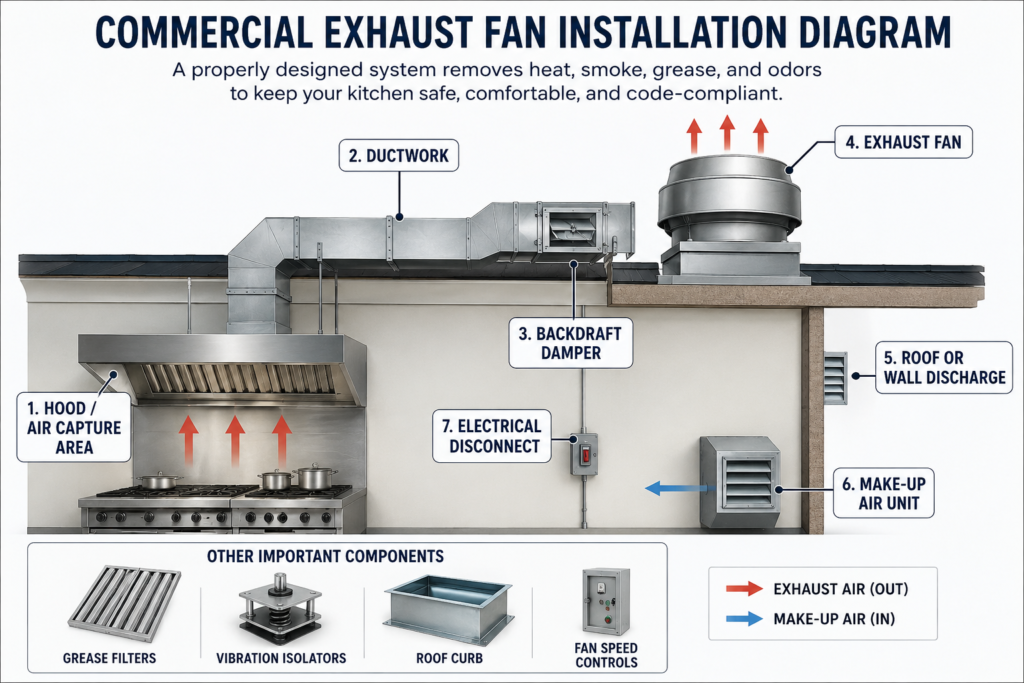
A commercial exhaust fan installation diagram may appear straightforward, but the actual system contains several interconnected components.
Typical components include:
- hood system
- exhaust fan
- ductwork
- roof curb or wall housing
- grease filters
- dampers
- electrical controls
- make-up air systems
- vibration isolation mounts
In kitchen environments, the fan is only one part of the ventilation system. Proper air replacement is equally important. Without make-up air, buildings can develop negative pressure, which affects HVAC performance, causes doors to slam, and can even disrupt combustion appliances.
CRS Hoods designs and fabricates these components as a complete, integrated system for commercial kitchens, with accurate CFM calculations and airflow documentation to confirm the system performs as designed.
How to install exhaust fan in kitchen environments
How to install exhaust fan in kitchen settings depends on whether the project is light commercial or full commercial-grade ventilation.
A professional installation usually involves:
- Calculating required airflow
- Designing proper duct routing
- Selecting the correct hood system
- Choosing a grease-rated exhaust fan
- Installing fire-safe duct materials
- Wiring electrical controls
- Balancing airflow with make-up air
- Testing airflow performance
One detail many beginner articles overlook is static pressure. Long duct runs, bends, grease filters, and roof caps all reduce airflow performance. A fan that appears powerful on paper may underperform significantly once installed if these resistance factors are ignored.
At CRS Hoods, this process follows a structured service approach: on-site airflow evaluation, repair or replacement planning, professional installation, and system testing with documentation for inspection readiness.
How to install heat extractor fan systems properly
How to install heat extractor fan systems depends heavily on the heat source and the operating environment.
Common applications include:
- bakeries
- boiler rooms
- laundry facilities
- warehouses
- mechanical rooms
- industrial production spaces
Heat extraction systems should be designed around:
- continuous airflow demands
- operating temperatures
- motor durability
- noise management
- maintenance accessibility
A practical issue professionals often encounter is uneven heat stratification. Heat does not always rise uniformly. Equipment placement, ceiling height, and supply air positioning can create hot spots even when a large fan is installed.
That is why airflow mapping matters during system planning.
How to install a kitchen extractor fan through a wall
How to install a kitchen extractor fan through a wall is common in smaller buildings where roof installation is impractical.
Wall-mounted installations require careful planning for:
- structural support
- waterproofing
- exterior discharge clearance
- grease discharge management
- local code compliance
The discharge location is particularly important. Exhaust outlets placed too close to entrances, windows, or HVAC intakes can create odor recirculation issues.
Signs your current exhaust system may be underperforming
Common warning signs include:
- excessive kitchen heat
- lingering smoke
- condensation buildup
- strong odors
- visible grease accumulation
- noisy fan operation
- uncomfortable staff working conditions
- poor airflow consistency
These symptoms often point to deeper airflow design issues rather than simple fan failure.
Expert insight: stronger airflow is not always better
One of the biggest misconceptions in commercial ventilation is that bigger fans automatically produce better results.
In reality, airflow balance matters more than raw fan power.
Oversized exhaust systems can create excessive negative pressure inside the building, leading to:
- HVAC inefficiency
- unstable temperatures
- door pressure issues
- combustion appliance interference
- uncomfortable drafts
Well-designed systems focus on balanced airflow between exhaust and make-up air.
Practical example: why a new fan sometimes fails to solve the problem
Consider a restaurant that replaces its exhaust fan because staff complain about excessive kitchen heat. After installation, the kitchen still feels uncomfortable.
The issue may not be fan capacity at all.
In many cases, the real problems are:
- undersized make-up air
- restrictive ductwork
- poor hood capture design
- excessive duct bends
- improper fan placement
This is why experienced installers evaluate the entire ventilation system rather than replacing components individually.
Actionable takeaway
Before installing or replacing a commercial exhaust fan, evaluate the entire airflow system:
- air removal
- replacement air
- duct routing
- static pressure
- equipment layout
- operating conditions
That single step prevents many of the performance problems businesses experience after rushed installations.
Best commercial exhaust fan installation: what defines a quality system
The best commercial exhaust fan installation is not necessarily the most expensive system. It is the one that:
- matches the building’s airflow requirements
- integrates properly with hood systems
- complies with local mechanical codes
- minimizes noise and vibration
- supports easy maintenance
- delivers consistent long-term performance
Reliable ventilation systems improve comfort, safety, and operational efficiency while reducing long-term maintenance headaches.
Maintenance after installation
Even properly installed systems require routine maintenance.
Maintenance should include:
- fan blade cleaning
- grease removal
- motor inspections
- belt checks
- airflow testing
- duct inspections
- vibration monitoring
Neglected systems lose efficiency quickly and may create fire hazards in commercial kitchens.
For commercial kitchens, CRS Hoods’ hood inspection and retrofit services, along with performance testing and CFM adjustments, help ensure these systems stay code-compliant and operating at peak performance over time.
In summary
Commercial exhaust fan installation is far more technical than simply mounting a fan and connecting ductwork. Proper ventilation affects employee comfort, indoor air quality, operational efficiency, fire safety, and code compliance.
The best results come from carefully designed systems that balance airflow, account for real operating conditions, and integrate properly with the building’s ventilation strategy. Since 1980, CRS Hoods has installed more than 10,000 commercial kitchen exhaust systems across Pennsylvania, New Jersey, Delaware, and Maryland, with systems that consistently pass inspection on the first attempt.
For businesses planning a new installation or replacing an underperforming system, professional system design and installation can prevent expensive long-term issues while delivering better airflow performance from day one.
If you are evaluating ventilation upgrades for your facility, CRS Hoods can help you design a commercial exhaust system built for real-world performance, reliability, and long-term efficiency.
FAQ Section
What is commercial exhaust fan installation?
Commercial exhaust fan installation is the process of installing ventilation equipment designed to remove smoke, grease, heat, fumes, and contaminated air from commercial buildings.
What is an Industrial Extractor Fan?
An Industrial Extractor Fan is a heavy-duty ventilation fan designed for warehouses, manufacturing spaces, workshops, and industrial environments where heat, fumes, or airborne contaminants must be removed continuously.
How do you install an exhaust fan in a commercial kitchen?
Installing an exhaust fan in a commercial kitchen involves calculating required airflow, integrating the fan with the hood system, installing fire-rated ductwork, balancing make-up air, and completing code-compliant electrical connections. At CRS Hoods, this process is planned as one coordinated system rather than a standalone fan swap.
Can a kitchen extractor fan be installed through a wall?
Yes, wall-mounted installation is an option when roof access isn’t practical, though it requires careful planning around structural support, discharge clearance, and local code requirements. CRS Hoods evaluates whether a wall or roof-mounted system is the better fit during the site assessment.
Why is make-up air important in commercial ventilation?
Make-up air replaces exhausted air to maintain balanced indoor pressure and proper HVAC operation. Without it, buildings can experience negative pressure and airflow problems.